Where Do Generative AI Services Deliver Repeatable Value?
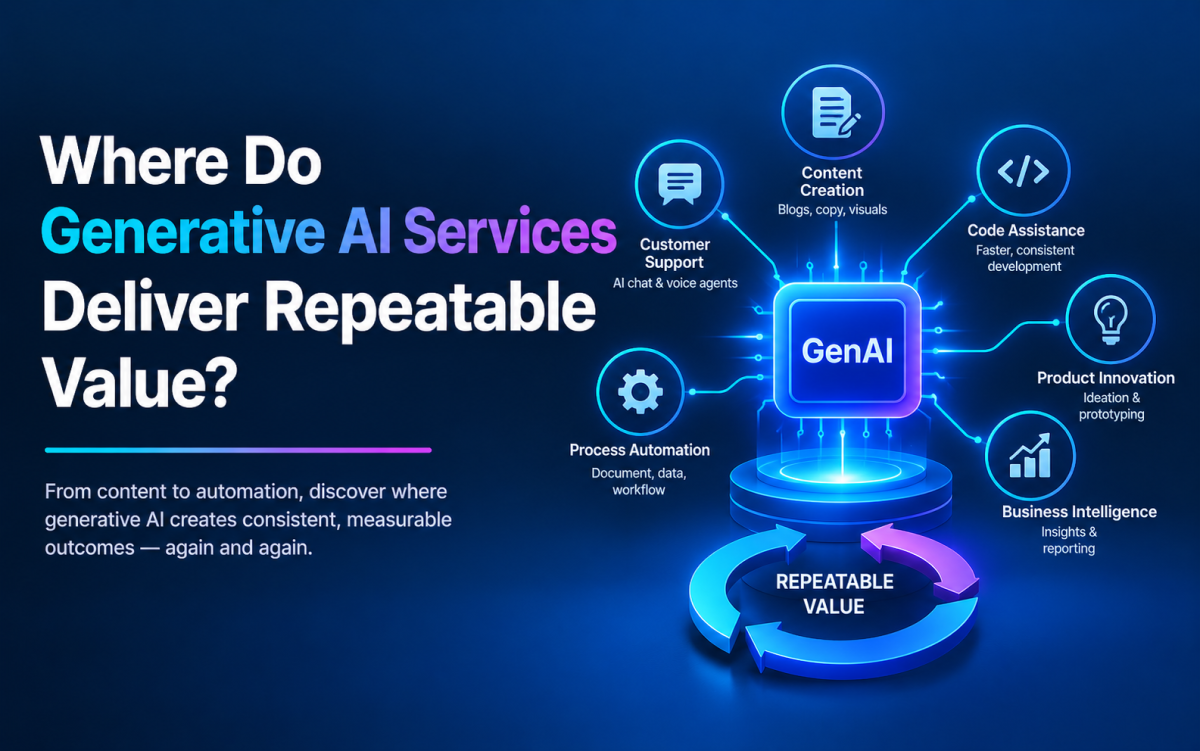
Two years of enterprise experimentation have produced a reasonably clear pattern about which generative deployments stay in production and which quietly stop being mentioned. It has little to do with model choice.
The systems that persist do one narrow thing, do it thousands of times a month, and produce output whose correctness someone can establish quickly. The systems that fade are broad, occasional, and produce output nobody can check without redoing the work.
That test is unglamorous and it predicts outcomes better than any capability assessment. It also explains the most-cited gap in the market: Stanford's AI Index reports organizational adoption reaching 88%. Almost everyone has deployed something. Very few have deployed something repeatable.
Property One: The Task Is Narrow
Narrow means the task can be described in a sentence, has a defined input type, and has a defined output shape.
"Extract the payment terms, renewal date, and termination notice period from a supplier contract into these five fields" is narrow. "Help the legal team work faster" is not, and the difference determines whether the system can be evaluated, priced, or improved.
Narrowness carries three practical benefits. The evaluation set is buildable, because the range of correct answers is bounded. The prompt or fine-tuned behavior can be optimized against that set rather than against opinion. And the failure modes are enumerable, which makes the guardrails writable.
The instinct to build broad comes from a reasonable place: a narrow tool feels like it under-uses a capable model. Resist it anyway. Three narrow deployments that each work are worth considerably more than one broad assistant that mostly works, and they can be evaluated separately when one of them stops working.
Property Two: The Volume Justifies the Engineering
Every production generative system carries fixed costs: evaluation, monitoring, guardrails, integration, and the engineering attention it needs each quarter. Those costs are roughly the same whether the system runs a hundred times a month or a hundred thousand.
Volume is therefore the amortization argument, and it should be checked with actual numbers before any build. Count how often the task happens today, how long it takes a person, and what that time costs. If the annual saving does not comfortably exceed the fixed costs plus the inference bill, the use case is a demonstration.
The threshold has been moving, and not in a helpful direction. Gartner expects generative cost per resolution in customer service to exceed $3 by 2030, above many offshore human agents, citing data center costs, vendor pivots toward profitability, and increasingly token-heavy use cases. Business cases built on the assumption that unit costs only fall are being built against the wrong curve.
Two structural responses help. Use the smallest model that clears the quality threshold, which is frequently much smaller than the one used in the prototype. And cache aggressively where inputs repeat, since a surprising share of enterprise requests are near-duplicates.
A third response is routing. Where a task has an easy majority and a hard minority, sending the easy cases to a small model and escalating the rest to a larger one typically cuts cost substantially with no measurable quality loss. The routing rule needs its own evaluation, since a misrouted hard case is worse than an expensive one, but the arithmetic usually justifies the effort well before the deployment reaches full volume.
Property Three: Somebody Can Check the Output
This is the property that decides whether generative AI services produce value or produce work.
A generated output that a person must verify from scratch has moved effort rather than removed it. If checking the summary requires reading the document, the summary saved nothing. The economics only work when verification is cheaper than production.
Three verification patterns work in practice.
Structural verification, where the output must conform to a schema, match a controlled vocabulary, or reconcile to a total. Field extraction from documents is the archetype, because the extracted values can be checked against the source automatically or validated against a system of record.
Downstream verification, where the next step in the process reveals correctness. A generated code change is verified by tests. A generated query is verified by whether it returns plausible results. A drafted response is verified by whether the customer replies with the same question again.
Sampled human verification, where a reviewer checks a proportion rather than everything, which works when the error rate is known and the consequence of an occasional error is tolerable.
Where none of the three applies, the use case is weak regardless of how impressive the output looks. Legal advice, strategic analysis, and open-ended research all fail this test in enterprise settings, which is why they generate enthusiasm and rarely generate a production system.
Where Generative AI Services Repeat Reliably
Four categories satisfy all three properties across most industries, and they are where the durable deployments cluster.
Document Field Extraction: Contracts, invoices, claims, applications, and forms, where the output is structured and checkable against the source.
Classification and Routing of Free Text: Complaints, support requests, and inbound correspondence, where volume is high and a confidence threshold can route uncertain cases to a person.
Drafting Inside a Template with a Reviewer: Standard correspondence, report sections, and product descriptions, where a human approves before anything leaves the building.
Code and Query Assistance with a Test Gate: Where correctness is established by an existing automated check rather than by opinion.
Three categories consistently disappoint. Open-ended knowledge assistants over a large corpus, because verification is expensive and the questions are unbounded. Executive summarization of complex material, because the value is in judgment nobody can check quickly. And anything generating content that goes directly to a customer without review, which is a governance problem before it is a quality one.
Generative AI development services worth engaging will tell you which category your idea falls into during the first conversation, and will say so when it falls into the second group.
Generative AI Solutions That Beat the General-Purpose Assistant
The most common enterprise deployment is a general assistant made available to everyone, and it is the hardest to defend at budget time.
The benefit is real. Many people save small amounts of time on varied tasks. The problem is that diffuse benefits produce no line item. Nobody's headcount changed, no process got faster in a measurable way, and the finance team sees a subscription with no offsetting entry.
Worse, general assistants resist evaluation. With no defined task, no evaluation set exists, no threshold applies, and nothing indicates whether a model change made things better or worse. The system becomes unimprovable and unfalsifiable at the same time.
The alternative is not to ban the assistant. It is to stop treating it as the program. Fund it as a productivity tool with a modest budget and no ROI claim, then run the actual program as two or three narrow, high-volume, verifiable deployments that each produce a number.
Gartner projects that 40% of enterprise applications will feature task-specific agents by 2026, up from less than 5% the year before. Much of the general-purpose capability will arrive inside software already licensed, which strengthens the case for spending your own engineering on the narrow things nobody will ship to you.
The Retrieval Layer Decides Quality More Than the Model
For most of the repeatable categories, the generation step is the easy part and retrieval is where quality is won or lost.
Systems that answer from a corpus fail predominantly by fetching the wrong material rather than by reasoning badly about the right material. That distinction matters because the two failures have completely different remedies: one is a search problem, the other is a prompting problem, and teams routinely spend weeks on the second while the first goes unexamined.
Three retrieval decisions carry most of the weight. How documents are divided, since chunks that split a table from its heading or a clause from its definition guarantee incomplete context. How results are filtered, since metadata such as effective date, jurisdiction, and product line usually matters more than semantic similarity. And how currency is enforced, since a superseded policy document retrieves as confidently as the current one.
Measure retrieval separately from generation. For a sample of real questions, record whether the correct source appeared in the retrieved set at all. Where it did not, no amount of model quality helps, and the fix is in the index.
Content maintenance follows from that and needs an owner. The corpus a system reads from will decay as products change and policies get superseded, and an unowned corpus degrades the system silently. Name the person, give them a quarterly review, and treat their hours as part of the running cost rather than as goodwill.
Measuring Whether It Repeats
Repeatability is an operational property, so measure it operationally.
Track volume processed and the share requiring human intervention, weekly. A rising intervention rate is the earliest signal that the system is drifting or that the input mix has changed.
Track cost per unit alongside quality, so an accuracy improvement that tripled the token count is visible as a trade rather than a win.
Track the check itself. Where verification is sampled, record the sampled error rate over time; where it is structural, record how often the structure check fails. A verification method that never fails is usually not being applied.
Then hold a quarterly review that asks one question: would you build this again knowing what you now know? For a genuinely repeatable deployment the answer is obvious. For the others it prompts a useful conversation about whether to narrow the scope or stop.
A note on selecting a partner. Ask any generative AI development company for a deployment they run today, the volume it handles, and how correctness is established. Firms with production systems answer in specifics. Firms without them describe capabilities.
Generative AI solutions repeat where the task is narrow, the volume is high, and the output can be checked more cheaply than it was produced, which is a test any team can apply to its own backlog in an afternoon. Professional providers scope engagements against those three properties, and teams reviewing candidates can start with a generative AI use case assessment rather than a platform decision. Take your three most-discussed ideas and write down, for each, who checks the output and how long that takes.
About the author
- Independent AI market research analyst with a strong interest in emerging AI technologies, industry trends, and competitive landscapes. I share research-backed perspectives on how AI is evolving and where new opportunities are emerging.
Comments
Join the discussionNo comments yet. Be the first to comment.
